
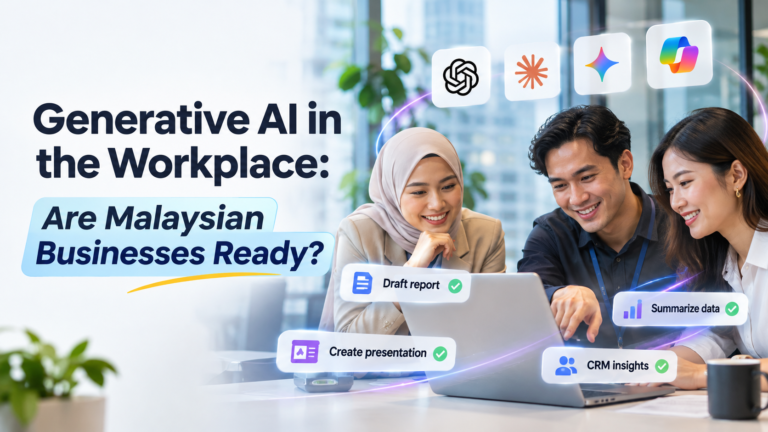
Artificial intelligence is no longer something reserved for technology companies or software developers. It is gradually becoming part of the tools people use every day from Microsoft Excel and Outlook to CRM platforms and business reporting systems.
Employees can now use AI to summarize customer interactions, prepare business reports, generate presentations and analyze information that would otherwise require hours of manual work. However, there is a growing gap between having access to these tools and knowing how to use them effectively.
A growing number of businesses are introducing AI into their operations but are their employees equipped to take advantage of it?
AI Is Entering the Workplace Whether Employees Are Ready or Not
The way businesses operate is changing. Software providers are increasingly integrating AI capabilities directly into their existing platforms which allows employees to work with AI without necessarily opening a separate chatbot.
Consider some of the developments already taking place:
- Microsoft Copilot: Integrated into Microsoft 365 applications, helping employees work with documents, spreadsheets, presentations and emails.
- Salesforce Agentforce: Introduces AI agents into CRM workflows to assist with customer service and sales operations.
- Google Gemini: Brings AI assistance into applications such as Gmail, Google Docs, Sheets and Slides.
- ChatGPT and Claude: Standalone AI assistants that can help with research, document creation, information analysis and other knowledge-based tasks.
These developments point towards a workplace where AI is becoming part of everyday business software rather than remaining a separate technology.
Microsoft's 2026 Work Trend Index found that 69% of Malaysian AI users say they are producing work they could not have produced a year earlier. However, only 32% say their organization's leadership is clearly and consistently aligned on AI adoption.
This highlights an important distinction: employees may already be experimenting with AI but organizations still need to establish the skills, processes and direction required to make it useful at scale.
Knowing How to Use AI Is Different From Knowing How to Work With It
Most people have heard of ChatGPT. Some use it to plan holidays, generate ideas, ask questions or write messages but workplace applications go much further.
Consider how different departments could incorporate AI into their daily responsibilities:
Sales and Customer Relationship Management (CRM)
Employees can use AI to summarize customer interactions, prepare follow-up emails, organize customer information and assist with sales proposals.
Administration and Human Resources
AI can help draft job descriptions, organize information, summarize lengthy documents and prepare internal communications.
Management and Business Reporting
Employees can use AI to interpret business information, identify trends, summarize performance figures and turn findings into management reports.
Marketing and Communications
AI can assist with campaign planning, content development, market research and presentation preparation.
The objective is not to replace existing applications or allow AI to make every decision. It is to help employees complete specific tasks more efficiently while maintaining responsibility for the final output.
From Writing Prompts to Creating Actual Business Deliverables
One of the most important skills in working with generative AI is prompt engineering.
Simply asking ChatGPT to write a report may produce a generic response. However, providing the right context, instructions, reference materials and expected format can produce something much more useful.
For example, an employee could provide meeting notes and ask AI to produce a structured report containing key discussions, decisions and action items.
A management team could provide performance figures and request a presentation outline highlighting important trends and potential areas of concern.
An HR employee could provide a job description and ask AI to refine the responsibilities, requirements and qualifications into a structured recruitment document.
These are not complicated AI development projects. They are practical applications that employees can learn and incorporate into their existing responsibilities.
Beyond prompt engineering, employees should also understand how to:
- Work with different AI tools such as ChatGPT, Claude and Gemini.
- Generate structured reports, business documents and presentations.
- Use AI to summarize and interpret information.
- Improve repetitive workflows through AI-assisted processes.
- Verify AI-generated information and recognize potential inaccuracies.
- Handle confidential business information responsibly.
The real value of AI literacy lies in knowing when to use AI, how to communicate with it and how to evaluate the results.
Why AI Training Is Becoming a Business Priority
The difference between AI adoption and AI proficiency is becoming increasingly important.
According to EY's 2025 Work Reimagined Survey, only 12% of Malaysian employees receive sufficient AI training to fully benefit from its capabilities.
Meanwhile, EY found that 81% of Malaysian employees who actively use generative AI report significant time savings.
The opportunity is clear. Employees who understand how to incorporate AI into their responsibilities can potentially improve productivity, reduce repetitive work and focus more time on tasks that require human judgment.
For employers, investing in AI training is also a way to strengthen workforce competitiveness.
Rather than expecting employees to figure out new technologies independently, organizations can provide structured learning opportunities that help their teams develop relevant skills.
AI literacy is no longer exclusively a technical competency. It is becoming increasingly relevant to employees across administration, sales, marketing, management, operations and other business functions.
Preparing Your Workforce Through Practical AI Training
Understanding AI in theory is only the starting point. Employees need opportunities to experiment with the tools, practice different techniques and apply what they learn to actual workplace scenarios.
This is where structured corporate training becomes valuable.
Through WipData Academy, businesses can explore practical Generative AI training designed to help employees understand and apply AI technologies in their everyday work.
Training can cover areas such as:
- Prompt Engineering: Learning how to structure instructions and provide context to generate more relevant and useful AI outputs.
- AI-Assisted Document Creation: Using generative AI to prepare reports, proposals, business documents and other written materials.
- AI-Powered Presentations: Turning information and ideas into structured presentation content.
- Workplace Productivity: Applying AI to research, summarization, information organization and repetitive tasks.
- AI Literacy and Responsible Usage: Understanding AI limitations, verifying outputs and using AI appropriately within business environments.
The aim is to move employees beyond casual experimentation and help them develop practical skills they can bring back to their respective roles.
Eligible employers can also explore HRD Corp claimable training opportunities to support employee development, subject to applicable eligibility and funding requirements.
Don't Let Your Workforce Fall Behind the Technology
AI is changing how people create documents, communicate, analyze information and manage their daily responsibilities.
As these capabilities become increasingly integrated into business software, employees who understand how to use them effectively will be better positioned to adapt to changing workplace expectations.
At WipData, we believe that successful AI adoption starts with people. Through practical training and workforce development, we help businesses build the knowledge and skills needed to make better use of emerging technologies.