
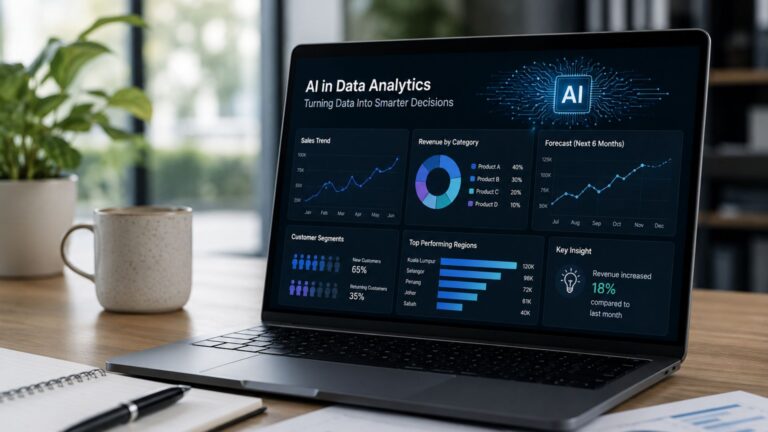
Artificial Intelligence (AI) has rapidly evolved from an emerging technology into one of the most transformative forces in business. Organizations today generate enormous amounts of data through customer interactions, financial systems, websites, mobile applications, IoT devices, enterprise software, and cloud platforms. While collecting data has become easier than ever, making sense of that information remains one of the biggest challenges facing businesses.
Data alone does not create value. The true advantage comes from understanding what the data means and using it to make better business decisions.
This is where AI is changing the future of data analytics.
Instead of spending hours preparing reports, cleaning spreadsheets, or writing complex database queries, businesses can now use AI to automate repetitive tasks, uncover hidden patterns, predict future outcomes, and even answer business questions using natural language. Rather than replacing analysts, AI enables them to work more efficiently by reducing manual work and allowing them to focus on solving strategic business challenges.
Across industries, organizations are investing in AI-powered analytics to improve productivity, reduce operational costs, strengthen forecasting, and make faster decisions. Businesses in Malaysia are also accelerating their adoption of AI as digital transformation continues to reshape sectors such as manufacturing, logistics, financial services, healthcare, and retail.
Whether you're beginning your analytics journey or looking to modernize an existing reporting process, understanding how AI fits into data analytics is becoming increasingly important.
In this guide, we'll explore what AI in data analytics really means, why it matters, how businesses are using it today, the technologies driving its growth, and how organizations can prepare for an AI-powered future.
What Is AI in Data Analytics?
AI in data analytics refers to the use of artificial intelligence technologies such as machine learning, natural language processing (NLP), computer vision, and generative AI to improve how data is collected, analyzed, interpreted, and presented.
Traditional analytics usually follows a familiar process:
- Collect data
- Clean the data
- Store the data
- Build dashboards
- Analyze trends
- Generate reports
- Make business decisions
Although these steps remain important, AI significantly enhances each stage.
Instead of manually searching through thousands of rows of information, AI can automatically identify unusual patterns, detect anomalies, summarize findings, generate forecasts, recommend actions, and even explain complex trends using simple language.
Imagine a sales manager asking:
"Why did revenue decline in March?"
Instead of requesting a report from an analyst and waiting several hours or even days, an AI-powered analytics platform can analyze millions of records, compare historical trends, identify the major contributing factors, and generate an explanation within seconds.
This allows analysts to spend less time creating reports and more time solving business problems.
AI does not eliminate traditional analytics. Instead, it builds upon it by making the entire process faster, smarter, and more accessible.
Why AI Is Revolutionizing Data Analytics
Businesses have never had access to more information than they do today.
Every customer purchase, website visit, mobile app interaction, online payment, GPS location, manufacturing sensor, and marketing campaign produces valuable data.
The challenge is no longer collecting information.
The challenge is extracting meaningful insights before opportunities disappear.
AI helps organizations transform raw data into actionable intelligence at a scale that would be impossible through manual analysis alone.
Faster Insights
Preparing reports traditionally involves extracting information from multiple systems, cleaning inconsistencies, writing SQL queries, validating calculations, building dashboards, and finally interpreting the results.
This process often takes hours or even days.
AI automates many of these repetitive tasks.
Reports can now be generated automatically, dashboards updated in real time, and important trends highlighted without requiring analysts to manually investigate every metric.
Instead of waiting for a weekly report, business leaders can receive insights as events happen.
This enables organizations to react more quickly to changing business conditions.
Better Forecasting
One of AI's greatest strengths is its ability to recognize patterns that humans may not immediately notice.
Machine learning algorithms can analyze years of historical data to forecast future outcomes such as:
- Sales demand
- Inventory requirements
- Customer churn
- Equipment failures
- Revenue growth
- Cash flow
- Operational risks
Rather than explaining what happened yesterday, AI helps businesses prepare for what may happen tomorrow.
This allows organizations to move from reactive decision making to proactive planning.
Automated Business Intelligence
Traditional dashboards display numbers and charts.
AI adds another layer by explaining what those numbers actually mean.
Instead of showing only a declining revenue chart, AI might generate an explanation such as:
"Revenue decreased by 12% compared to last month, primarily due to lower online sales and reduced customer retention among first-time customers."
This makes business intelligence far easier to understand, especially for decision makers who may not have technical or analytical backgrounds.
Natural Language Analytics
Perhaps one of AI's most exciting developments is conversational analytics.
Rather than learning SQL or navigating complicated dashboard filters, users can simply ask questions such as:
- Which products generated the highest profit?
- Why are operating costs increasing?
- Predict next quarter's sales.
- Which customers are likely to stop purchasing?
- What changed compared to last month?
AI converts these questions into analytical queries before presenting visualizations, explanations, and recommendations.
This dramatically lowers the barrier to analytics, allowing more people within an organization to make data-driven decisions.
How AI Is Changing Traditional Analytics
For many years, business intelligence focused primarily on answering one question:
What happened?
Dashboards summarized historical performance using charts, tables, and KPIs. Analysts would interpret the results before presenting recommendations to stakeholders.
AI expands this process considerably.
Instead of stopping at historical reporting, AI helps organizations answer additional questions:
- Why did it happen?
- What is likely to happen next?
- What should we do about it?
This shift transforms analytics from a reporting function into a decision support system.
Businesses no longer need to wait until problems become obvious.
AI continuously monitors business performance, detects unusual activity, predicts future outcomes, and recommends actions before issues escalate.
Rather than replacing business intelligence, AI represents the next evolution of analytics.
Real Business Applications of AI in Data Analytics
One of the reasons AI has gained widespread adoption is its ability to solve practical business problems across almost every industry.
While the underlying technology may differ, the objective remains the same: helping organizations make better decisions using data.
Manufacturing
Manufacturers generate enormous amounts of operational data every day.
Production lines, machinery, quality inspections, maintenance systems, and IoT sensors all contribute valuable information that can improve efficiency.
AI helps manufacturers:
- Predict equipment failures before they occur
- Reduce production downtime
- Optimize maintenance schedules
- Improve quality control
- Forecast production demand
- Identify bottlenecks within manufacturing processes
Given Malaysia's strong manufacturing sector, predictive analytics is becoming increasingly valuable for organizations seeking to improve productivity while reducing operational costs.
Retail
Retail businesses rely heavily on understanding customer behavior.
AI enables retailers to:
- Forecast inventory demand
- Recommend products
- Analyze purchasing patterns
- Optimize pricing strategies
- Identify seasonal trends
- Personalize customer experiences
Instead of reacting after products go out of stock or demand changes unexpectedly, retailers can anticipate customer needs much earlier.
Financial Services
Banks and financial institutions process millions of transactions every day.
AI supports a wide range of analytical applications including:
- Fraud detection
- Credit risk analysis
- Financial forecasting
- Customer segmentation
- Compliance monitoring
- Spending pattern analysis
By identifying unusual transaction behavior in real time, AI improves both operational efficiency and customer security.
Healthcare
Healthcare organizations increasingly use AI to improve both patient care and operational planning.
Examples include:
- Predicting patient admissions
- Optimizing appointment scheduling
- Supporting medical image analysis
- Managing hospital resources
- Identifying treatment trends
Rather than replacing healthcare professionals, AI provides faster insights that support better clinical and operational decisions.
Marketing
Marketing teams have become some of the biggest adopters of AI-powered analytics.
AI helps businesses:
- Analyze customer segments
- Predict customer lifetime value
- Optimize advertising budgets
- Personalize marketing campaigns
- Measure campaign performance
- Generate automated marketing reports
Instead of manually reviewing dozens of dashboards, marketing teams receive prioritized insights that help them respond more quickly to changing customer behavior.
Popular AI Tools Used in Data Analytics
Successful AI adoption depends less on choosing the "best" software and more on selecting the right solution for your organization's goals, existing technology, and data maturity.
Several platforms have become widely recognized for integrating AI into modern analytics workflows.
Microsoft Fabric and Power BI Copilot combine data engineering, business intelligence, and AI into a unified platform. Users can generate reports, summarize dashboards, explain trends, and build visualizations using natural language, making analytics more accessible to both technical and non-technical teams.
ChatGPT has become an increasingly valuable productivity tool for analysts. It assists with writing SQL queries, explaining Python code, creating DAX measures, documenting data models, summarizing reports, and brainstorming analytical approaches. While human validation remains essential, AI significantly reduces repetitive work and accelerates everyday analytical tasks.
Databricks is widely used for large-scale data engineering, predictive analytics, and machine learning. Organizations managing large volumes of structured and unstructured data often rely on Databricks to develop advanced AI models and automate complex analytical workflows.
Snowflake Cortex AI enables organizations to apply generative AI directly to enterprise data while maintaining governance and security. Rather than moving sensitive data between multiple platforms, businesses can analyze information within the same environment, simplifying AI adoption while reducing operational complexity.
These platforms demonstrate that AI is no longer a standalone technology. Instead, it has become an integrated capability within modern analytics ecosystems, helping organizations work more efficiently while making better business decisions.
Common Challenges Businesses Face When Adopting AI
Although AI offers significant advantages, successful implementation requires more than simply purchasing new software. Organizations that achieve the greatest success usually focus on building strong data foundations before introducing AI into their workflows.
Poor Data Quality
AI is only as reliable as the data it receives.
If business data contains missing values, duplicate records, inconsistent formatting, or outdated information, AI-generated insights become less accurate. Poor data quality often leads to incorrect forecasts, misleading recommendations, and reduced confidence in analytical results.
Before implementing AI, organizations should establish processes for maintaining clean, consistent, and trustworthy data.
Data Governance and Security
As AI becomes more deeply integrated into business operations, protecting sensitive information becomes increasingly important.
Organizations should establish clear policies regarding:
- Data ownership
- User access permissions
- Privacy compliance
- Data retention
- Security monitoring
Strong governance ensures AI systems operate responsibly while maintaining compliance with industry regulations and organizational policies.
Skills and Organizational Adoption
Introducing AI is not only a technology project. It is also a people project.
Employees need time to understand how AI works, when to trust its recommendations, and when human judgement should take precedence.
Providing analytics and AI training helps teams build confidence while encouraging responsible adoption across the organization.
Unrealistic Expectations
AI is often portrayed as a technology capable of solving every business problem automatically.
In reality, AI should be viewed as an intelligent assistant rather than a replacement for human expertise.
It accelerates analysis, identifies patterns, and generates recommendations, but strategic decisions still require business knowledge, industry experience, and critical thinking.
Organizations that understand this balance typically achieve far greater long-term success.
How Businesses Can Successfully Adopt AI
Many organizations believe AI adoption begins with selecting the latest AI platform.
In reality, successful implementation starts much earlier.
The first step is building a strong data foundation.
Without reliable data, even the most advanced AI models will struggle to produce meaningful insights.
A practical roadmap often looks like this:
Step 1: Consolidate Your Data
Business information is frequently spread across ERP systems, CRM platforms, accounting software, websites, spreadsheets, and cloud applications.
Bringing these data sources together creates a single source of truth that supports more accurate analytics.
Step 2: Improve Data Quality
Before introducing AI, organizations should clean and standardize their data.
Removing duplicate records, validating information, and maintaining consistent business definitions significantly improve AI performance.
Step 3: Build Meaningful Dashboards
Dashboards remain an important part of modern analytics.
Clear KPIs, standardized reporting, and reliable metrics provide the foundation that AI uses to generate insights and recommendations.
Step 4: Introduce AI Gradually
Rather than attempting to automate every business process immediately, organizations should begin with high-impact use cases such as:
- Automated reporting
- Sales forecasting
- Customer segmentation
- Inventory optimization
- Operational monitoring
- Executive summaries
Early successes help teams gain confidence while demonstrating measurable business value.
Step 5: Continuously Improve
AI models become more valuable as organizations collect additional data and refine their processes.
Successful AI adoption is an ongoing journey rather than a one-time project.
Businesses should regularly review AI recommendations, validate outputs, and identify opportunities for continuous improvement.
Can AI Replace Data Analysts?
This is one of the most frequently asked questions surrounding AI.
The short answer is no.
While AI excels at automating repetitive analytical tasks, it cannot replace human expertise, business understanding, or strategic thinking.
AI can:
- Generate reports
- Write SQL queries
- Explain trends
- Detect anomalies
- Build forecasts
- Summarize large datasets
However, AI cannot fully understand an organization's objectives, customer relationships, competitive landscape, or long-term strategy.
Data analysts continue to play a vital role by:
- Asking the right business questions
- Validating AI-generated insights
- Designing meaningful KPIs
- Interpreting complex findings
- Communicating recommendations to stakeholders
Rather than replacing analysts, AI enables them to become more productive by reducing manual work and allowing them to focus on higher-value activities.
The future of analytics is not human versus AI.
It is human expertise enhanced by AI.
Why Data Still Comes First
Many organizations become excited about AI before establishing reliable data practices.
Unfortunately, even the most advanced AI platforms cannot compensate for inaccurate, incomplete, or poorly structured data.
Businesses that invest in strong data governance, reliable reporting, and modern analytics infrastructure will consistently achieve better AI outcomes than those focusing solely on new technology.
This is why successful AI initiatives almost always begin with data rather than algorithms.
Organizations that build trustworthy data today will be better prepared to leverage increasingly advanced AI capabilities in the future.
Frequently Asked Questions About AI in Data Analytics
Is AI replacing data analysts?
No. AI automates repetitive analytical tasks but does not replace critical thinking, business knowledge, or human decision making. Data analysts remain essential for validating insights, interpreting results, and supporting strategic decisions.
Which industries benefit most from AI in data analytics?
Almost every industry can benefit from AI-powered analytics. Manufacturing, retail, finance, healthcare, logistics, telecommunications, and professional services are among the sectors already using AI to improve efficiency, forecasting, and operational performance.
Do I need programming skills to use AI analytics?
Not necessarily.
Many modern analytics platforms allow users to explore data using natural language instead of SQL or Python. However, technical skills remain valuable when building advanced analytical solutions or custom AI models.
Is AI-generated analysis always accurate?
No.
AI recommendations should always be reviewed by experienced professionals. High-quality data, strong governance, and human oversight remain essential for producing reliable business insights.
Is AI suitable for small and growing businesses?
Yes.
Cloud-based AI platforms have made advanced analytics more accessible than ever before. Organizations can begin with relatively small AI initiatives before expanding into more advanced use cases as their data maturity grows.
The Future of AI in Data Analytics
Artificial Intelligence is transforming data analytics from a reporting function into a decision support capability.
Instead of asking what happened last month, organizations can now ask:
- Why did it happen?
- What is likely to happen next?
- What should we do differently?
This shift enables businesses to move beyond historical reporting and toward predictive and prescriptive analytics, where decisions are supported by real-time insights and intelligent recommendations.
As AI technologies continue to mature, organizations that establish strong data foundations today will be better positioned to take advantage of future innovations.
The companies that succeed will not necessarily be those with the largest AI budgets.
They will be the organizations with the most reliable data, the clearest business objectives, and the strongest analytical capabilities.
How WipData Helps Businesses Unlock AI-Driven Analytics
Artificial Intelligence delivers its greatest value when it is supported by reliable data, well-designed analytics processes, and clear business objectives.
At WipData, we believe successful AI adoption starts long before implementing new technology. It begins with building a strong analytics foundation through data integration, business intelligence, dashboard development, analytics training, and modern reporting practices.
Once that foundation is in place, organizations are better equipped to introduce AI in ways that improve efficiency, automate repetitive tasks, generate actionable insights, and support smarter business decisions.
Whether your organization is beginning its analytics journey or exploring AI-powered business intelligence, investing in trusted data today creates the foundation for better decisions tomorrow.
By combining modern analytics with practical AI applications, businesses can transform data into one of their most valuable strategic assets.