
Industry-specific software is designed to make business operations easier. Whether it is manufacturing management, inventory tracking, production planning or financial reporting, these solutions provide businesses with tools tailored to their respective industries.
As businesses grow, their operational requirements become increasingly complex. What once worked perfectly may eventually become restrictive since reporting requirements change, different departments need access to different information, and management expects greater visibility into daily operations.
The problem is that businesses often end up adapting their processes to fit the limitations of their software, rather than having software that adapts to the way they actually work.
So, is industry-specific software still enough?
1. When Standard Software Stops Meeting Business Needs
Off-the-shelf software is generally built around standardized workflows. This makes implementation easier, but it also means businesses may have limited flexibility when their requirements differ from the intended design.
Consider a manufacturing business.
Its existing system might already track production output, inventory and machine performance. However, management may want to combine these figures into a single report to compare production efficiency across different facilities or monitor operational performance using additional data sources.
If the existing software cannot accommodate these requirements, businesses may resort to exporting spreadsheets and manually consolidating information or purchasing additional reporting tools.
Over time, this creates disconnected systems, duplicated work and limited visibility.
The software may still be functioning as intended but it is no longer meeting the business's actual needs.
2. Better Reporting Requires More Than Just Another Dashboard
One of the biggest limitations of standardized business software is reporting flexibility.
Businesses rarely have identical reporting requirements, even when they operate within the same industry.
For example, a manufacturing company may need to monitor:
- Production output against daily targets.
- Machine utilization and downtime.
- Inventory movements and material consumption.
- Operational costs and resource efficiency.
- Performance across different production lines.
While standard software may provide basic reporting capabilities, businesses often need more customised measurements, reporting structures and data relationships.
Custom reporting solutions allow businesses to bring information from multiple systems into a centralised environment, giving management a clearer picture of operational performance.
Instead of relying on several disconnected reports, decision-makers can access information structured around their actual business requirements.
3. What If Your Existing Systems Could Work Together?
Businesses do not necessarily need to replace their entire software infrastructure to improve their operations.
In most cases, the bigger opportunity lies in connecting existing systems.
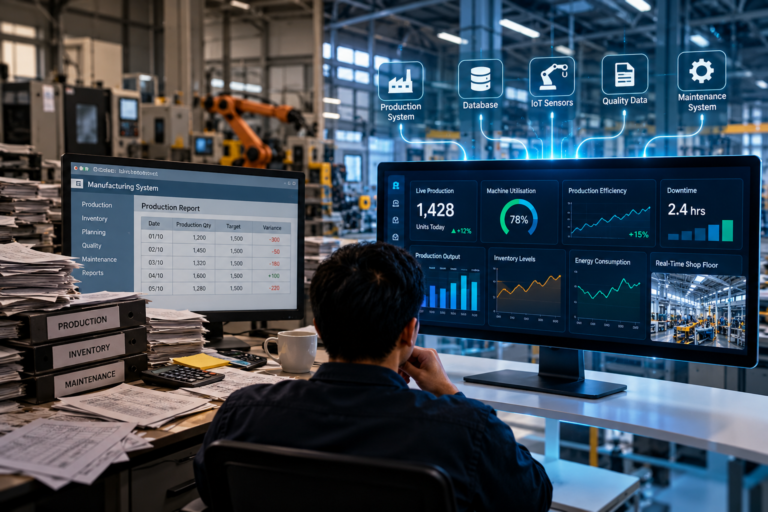
A manufacturing environments may generate information through production management systems, databases, machinery and IoT devices. By developing custom data connectors and integrating these sources, businesses can bring previously disconnected information into their reporting environment.
This creates opportunities for more comprehensive operational tracking, automated reporting and real-time monitoring, depending on the available data and infrastructure.The same approach applies beyond manufacturing. Businesses can connect information across departments, platforms and operational processes without relying entirely on a single software provider.
4. Custom Software Is Not About Replacing Everything
Custom software does not necessarily mean building an entirely new system from scratch as it involves developing additional functionality around existing systems, integrating different data sources, automating repetitive processes or creating reporting solutions that standard software cannot provide.
With the growing availability of AI and automation technologies, businesses can also explore more advanced capabilities.
Examples include:
- Automated data collection and report generation.
- AI-assisted analysis of operational performance.
- Custom dashboards tailored to specific business requirements.
- Automated notifications when operational targets or thresholds are breached.
- Integrated data environments that consolidate information from multiple sources.
The objective is not to introduce technology simply because it is available but to address limitations that prevent businesses from operating efficiently.
5. How Do You Know When Your Business Needs Custom Software?
Not every business needs a fully customized solution. However, several signs suggest that existing software may no longer be sufficient:
- Employees regularly export data into spreadsheets to complete reports.
- Management struggles to obtain a consolidated view of business performance.
- Existing software cannot accommodate specific operational requirements.
- Different departments rely on disconnected systems.
- Reporting and data consolidation consume too much time.
- Integrating new technologies or data sources is increasingly difficult.
If these challenges sound familiar, it may be time to evaluate whether custom software, additional integrations and automated reporting could provide a better fit.
Build Around Your Business, Not Your Software
Industry-specific software provides a valuable starting point but businesses should not have to compromise their operational requirements simply because their software has limitations. When certain things like reporting expectations, data requirements and business processes evolve, organizations need solutions that can evolve alongside them.
Whether it involves customized reporting, automated workflows, IoT data integration or AI-powered analytics, the right technology should work around the way a business operates.
At WipData, we believe technology should be built around business needs, not the other way around.
Is your existing software keeping up with your business?
Explore how WipData can help you develop more flexible data analytics, reporting, automation and software solutions.